The below open letter email was sent to all Merri-bek Councillors on December 30, 2024. It is in regard to citizen petitions and how Councillors and Council initially deal with and respond to petitions as part of Council Governance and listening to the community. It arises from a petition presented at the December 2024 meeting that almost failed to be accepted.
John Englart prefaced his communication to Councillors saying “Since the December Council meeting I have been mulling over the discussion and voting on the Hosken East Petition and Petitions generally. The voting result troubled me. It even entered my dreams. So I have put pen to paper (metaphorically speaking) to articulate what I found troubling. I have also had limited discussions with a couple of you about this issue. I don’t really expect responses, but I would ask you to reflect on what I am putting forward as part of listening to the community and good governance at Council.”
Photo: John Englart. Uncle Bill Nicholson Welcome to Country and smoking Ceremony.
A large crowd gathered on the Merri Creek Trail at Moomba Park in Fawkner on Saturday morning. This was the celebration and opening of a wetlands system that diverts stormwater from Somerlayton Crescent through a series of four ponds before flowing into Merri Creek.
Varied water depth, wetlands vegetation and rocky areas provide ideal breeding areas for a variety of frogs and lizards. This includes the endangered Growling Grass Frog. In February 2024 a frog survey found that Growling Grass Frogs were already breeding at this site. The wetlands system has been in design and construction since March 2021.
The official opening had a Welcome to Country and smokng ceremony by Uncle Bill Nicholson representing the Wurundjeri Woiwurrang, that gave some history, cultural importance of caring for country and respect for all, including the new diverse stories that new people bring and share.
The Mayor Adam Pulsford also spoke on Council sommitment to improve the natural environment. The wetlands system was constructed with $500,000 frunding by Merri-bek Council and $500,000 funding from Melbourne water. The wetlands filters pollution from stormwater that would otherwise flow into Merri Creek, the Yarra River and Port Philip. It also creates habitat for many species including endangered frogs, lizards and butterflies.
Friends of Merri Creek provided watery trays of pond wildlife for people to see.
Local Broadmeadows MP Kathleen Matthews Ward (who represents Fawkner) formerly opened this wetlands system on behalf of the Victorian State Labor Government.
You are invited to the Merri Creek BirdWatch surveys on Sunday 5 May and Sunday 19 May from 8:45 – 10:30am.
Choose a site near you to enjoy your local birds, or explore a different part of the Merri – see the list below. Beginner-birders are welcome to our surveys, as well as experienced birders.
Melbourne water has been consulting on opening up access and improving some facilities of three retarding basins in Merri-bek’s northern suburbs: Jack Roper Reserve/CSL; Campbellfield Creek; and Box Forest Road retarding basins.
As part of facilitated site tours by Melbourne Water on March 23 we visited Jack Roper Reserve flood retarding basin, Campbellfield Creek flood retarding Basin And Box Forest Road flood retarding basin. Timeline for delivery is 2-5 years.
Both Jack Roper Reserve and Box Forest Reserve retarding basins do flood mitigation on the Merlynston Creek (See Merlynston Creek from source to confluence). Campbellfield Creek once was a tributary of Merlynston Creek with the old water course in the Fawkner cemetery still visible, The water now plundges into an underground drain at Box Forest Road where it is piped to meet the Merri Creek at the bottom of Fawkner.
Sunday 17 September, 10am-12pm East end of Lorne St, Fawkner – see Google map Register: FB Event
Find out about the history and future plans for creek restoration and maintenance along the southern section of Merri Creek, Fawkner.
Featuring Michael Longmore, MCMC Ecological Restoration Program Manager, and Anne Frost, Coordinator of Friends of Merri Creek’s Wednesday Volunteers. Wear shoes suitable for light walking (approx. 3.3km) and BYO water and snacks.
Note: At all times, children must be in the company of, and under the direct supervision of, their parent or guardian. Please don’t attend if you are feeling unwell and have any cold or flu-like symptoms. Organised by Friends of Merri Creek and supported by MCMC.
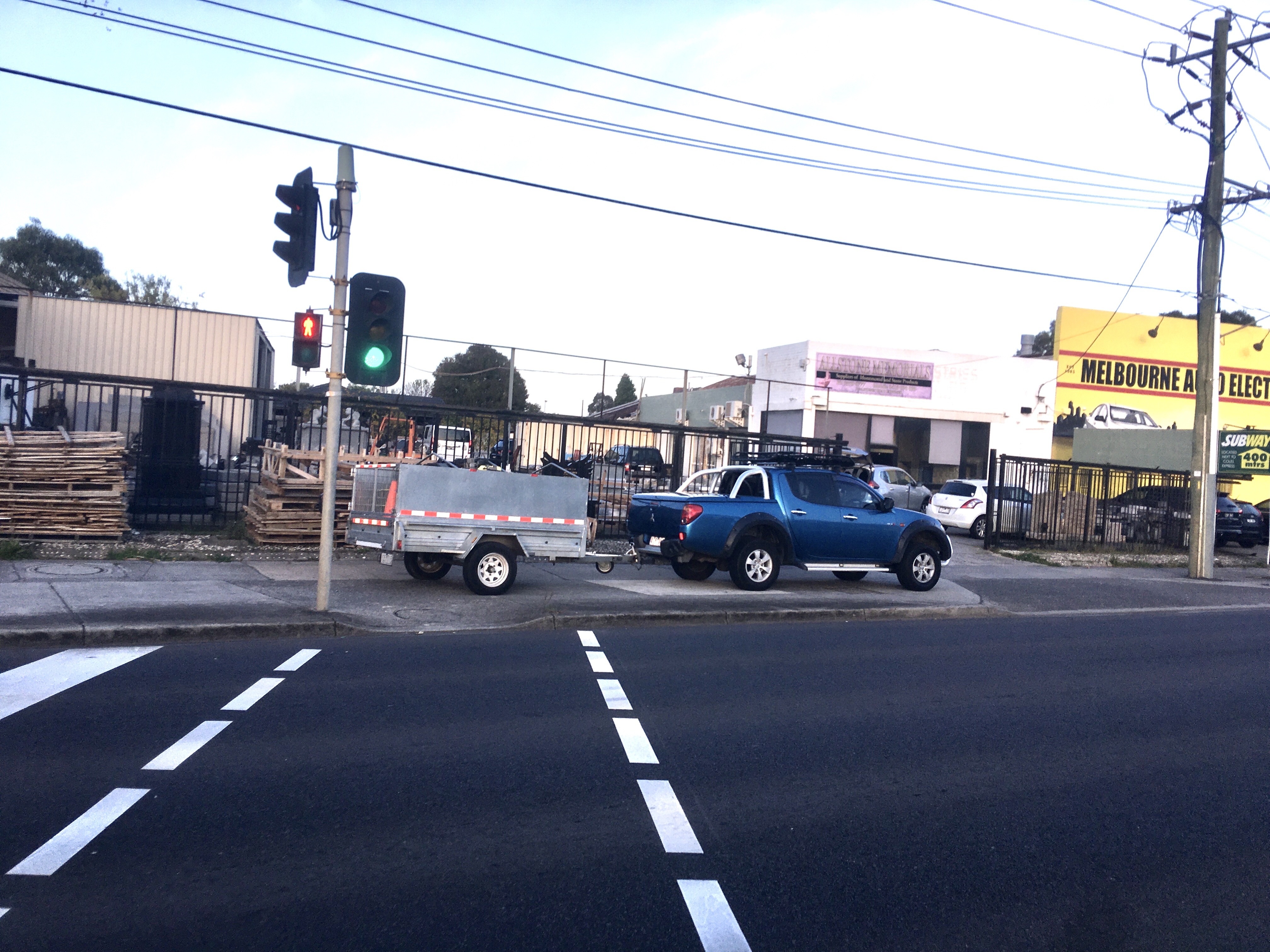
Vehicle and Trailer on Nature strip obstructing pedestrian crossing ramp at Box Forest Road/Sydney Road, Fawkner (A regular occurrence)
Sustainable Fawkner teamed up with Climate Action Merribek to preparare this submission to a Legislative Assembly Inquiry into the impact of road safety behaviours on vulnerable road users. It was submitted 19 May 2023.
We started with highlighting problem locations around Merri-bek municipality, particularly in the northern suburbs such as Fawkner. This is by no means a comprehensive list but more illustrative of the many issues facing vulnerable users at specific locations. We then highlighted the need to address infrastructure to address safety and also as a response to reduce transport emissions. We came up with the following recommendations:
Invest in Safer infrastructure for vulnerable road users. Increasing safety for vulnerable road users means investing in safer footpaths, crossings, separated bike paths and protected bike lanes, and where pedestrian and cycling traffic is low, more shared use bike paths.
More Safety signage. It also means that more safety signage at key intersections is used warning drivers of both pedestrian and cycling activity, including early start signage for cyclists.
Driver Education. In the past too much emphasis has been placed on changing behaviours of vulnerable road users for their own safety as part of education campaigns. This amounts to ‘Blaming the Victim’. There needs to be a much greater focus on drivers sharing public roads, with an emphasis on safety, and also encouraging use of cycling and walking for local trips.
Addressing safety of vulnerable road users needs to also address the need to reduce transport emissions. The saftey of vulnerable road users and the need to change mobility behavious to reduce emissions should both drive more investment in active transport infrastructure. As dedicated infrastructure improves there is likely to be a compounding increase of active transport mode share reflecting the improved safety environment for vulnerable road users. This requires a boost to recurrent funding for active transport as a proportion of Transport funding in the Victorian budget
Build safe cycling infrastructure along the Strategic Cycling corridors. Sometime, like the extension of the Upfield bike path beyond the M80, this is entirely new infrastructure waiting to be built.
Increase funding to active transport to 20 percent of the state transport budget, as recommended by the United Nations.
The Legislative Assembly Economy and Infrastructure Commitee plans to hold public hearings later this year and will report to Parliament in March 2024.
If we learnt anything from the past federal election, it’s that Australians care about climate change and nature. A survey released this week suggests the same dynamic is at play as we head into the Victorian state election.
The poll, prepared for the Victorian National Parks Association, found 36% of Victorians say their vote would be influenced by policy announcements regarding saving threatened species and stopping extinction.
The Victorian government’s own surveys have highlighted the enormous number of people who value nature. And research this year for the Australian Conservation Foundation found 95% of Australians agree it’s important to protect nature for future generations.
Despite the weight of public concern, Victoria is failing its wildlife. Last year the Victorian Auditor General’s Office handed down a damning report on biodiversity protection. It concluded that about a third of Victoria’s land-based plants, animals and ecological communities face extinction, their continued decline will likely have dire consequences for the state, and funding to protect them is grossly inadequate.
We know what’s primarily behind Australia’s extinction crisis: land clearing, invasive species and climate change-induced impacts such as extreme bushfires.
So, what have the different political parties promised in the lead up to the Victorian election, and how do they stack up? Here’s a brief guide to what’s on offer.
Climate Analytics rating of Major Parties and Teal Independents.
We know you’ll be wanting to compare the major parties for the 2022 Federal Election scheduled for the 21st May. We are collecting 3rd party scorecards that compare different policy aspects of political parties. We are prioritising scorecards for climate, biodiversity and environment. This page will update as the election campaign progresses.




 Sustainable Fawkner